Starting Weight Training on Mounjaro: The Questions Everyone's Asking
If you're on Mounjaro or another GLP-1 and you've started wondering whether you should be lifting weights, you're not alone — and you're asking the right question at the right time.
Spend ten minutes in any Mounjaro group and the same worries come up again and again. I coach beginners for a living, I specialise in helping people on these medications hold onto their muscle, and I dropped 30kg myself while keeping the muscle I'd built. So let me work through the questions that come up most — the honest way, without the gym-bro noise.
"When should I start lifting?"
This is the big one, and the answer is simpler than people expect: now.
Not when you've lost the weight. Not when you feel "gym ready." Not when the appetite comes back. The whole point of training while you're losing is to tell your body that the muscle you've got is still needed. Wait six months and you'll have already given some of it away — and it's a lot harder to build muscle back than it is to keep what you have.
Starting now doesn't mean throwing yourself into an intense programme. It means two or three sensible sessions a week, done properly. That's enough to change the outcome.
"Will I lose muscle on Mounjaro?"
Some, yes — and that's normal for any weight loss, medication or not. When you lose weight, a portion of what comes off is lean mass. That's true whether you're dieting, on a GLP-1, or anything else.
The reassuring part: recent research on tirzepatide found that muscle changes were broadly in line with what you'd expect for that amount of weight lost — not some special muscle-melting effect of the drug. In other words, the medication isn't the villain here. What decides how much muscle you keep is what you do: lifting weights and eating enough protein. Those two levers are almost entirely in your control.
"How do I eat enough protein when I can barely eat anything?"
This is the honest struggle nobody warns you about. Mounjaro kills your appetite — that's the point — but it also makes hitting your protein target genuinely hard.
A few things that work for real people, not just fitness influencers:
- Eat protein first. When your appetite is small, spend it on the thing that matters. Protein before the carbs, before the sides.
- Drink some of it. A protein shake or high-protein milk goes down when a chicken breast just won't.
- Lean on easy wins. Greek yoghurt, cottage cheese, eggs, tinned fish, protein puddings. Low effort, high return.
You don't need to be perfect. You need to be consistent enough that your body has the raw material to protect your muscle. Aiming for protein at every meal, even a small one, gets most people 80% of the way there.
"I've got no energy in the gym — is that normal?"
Yes. Especially in the first few weeks, and often after a dose increase. You're eating far less than you used to, so of course the tank feels emptier.
This isn't a reason to quit — it's a reason to adjust. Keep the sessions shorter. Prioritise the important lifts. Stay on top of your water and electrolytes, because low appetite often means you're drinking less too. If a session feels flat, doing something still beats doing nothing. The consistency is what protects your muscle, not the heroics.
"Can a total beginner actually build muscle while losing weight?"
Often, yes — and this is the genuinely exciting bit for people who've never trained.
If you're new to lifting, your body is unusually responsive. Complete beginners can frequently build a bit of muscle and lose fat at the same time, especially in the early months. This is the sweet spot GLP-1 users are sitting in and don't realise: you've got the appetite control handling the fat side, and untrained muscles ready to respond to training. Miss this window and you're leaving results on the table.
It gets harder the leaner and more experienced you become — but that's a good problem for later. Right now, the odds are in your favour.
"What should a beginner routine actually look like?"
You do not need a complicated split, a fancy gym, or an hour and a half a day. For someone starting out on a GLP-1, a good week looks like:
- Two to three full-body sessions, spread across the week
- A handful of big, simple movements — a push, a pull, a squat or sit-to-stand, a hinge — that train a lot of muscle at once
- A weight that's challenging but doable for around 8–12 reps, left with a rep or two in the tank
- Gradual progress — a little more weight or one more rep as it gets easier
That's it. Simple, repeatable, and sustainable around real life. The people who succeed aren't the ones with the cleverest programme — they're the ones who still show up in month six.
The bottom line
Mounjaro is a brilliant tool for taking the fat off. Weight training is the tool that decides what's left underneath when you get there. Do the medication without the lifting and you risk arriving at your goal weight smaller but soft, tired, and weaker than you'd like. Do both together and you arrive lighter, stronger, and with a body that actually works the way you want it to.
You don't need to become a gym person. You just need a sensible plan and someone to show you the ropes so you're not guessing.
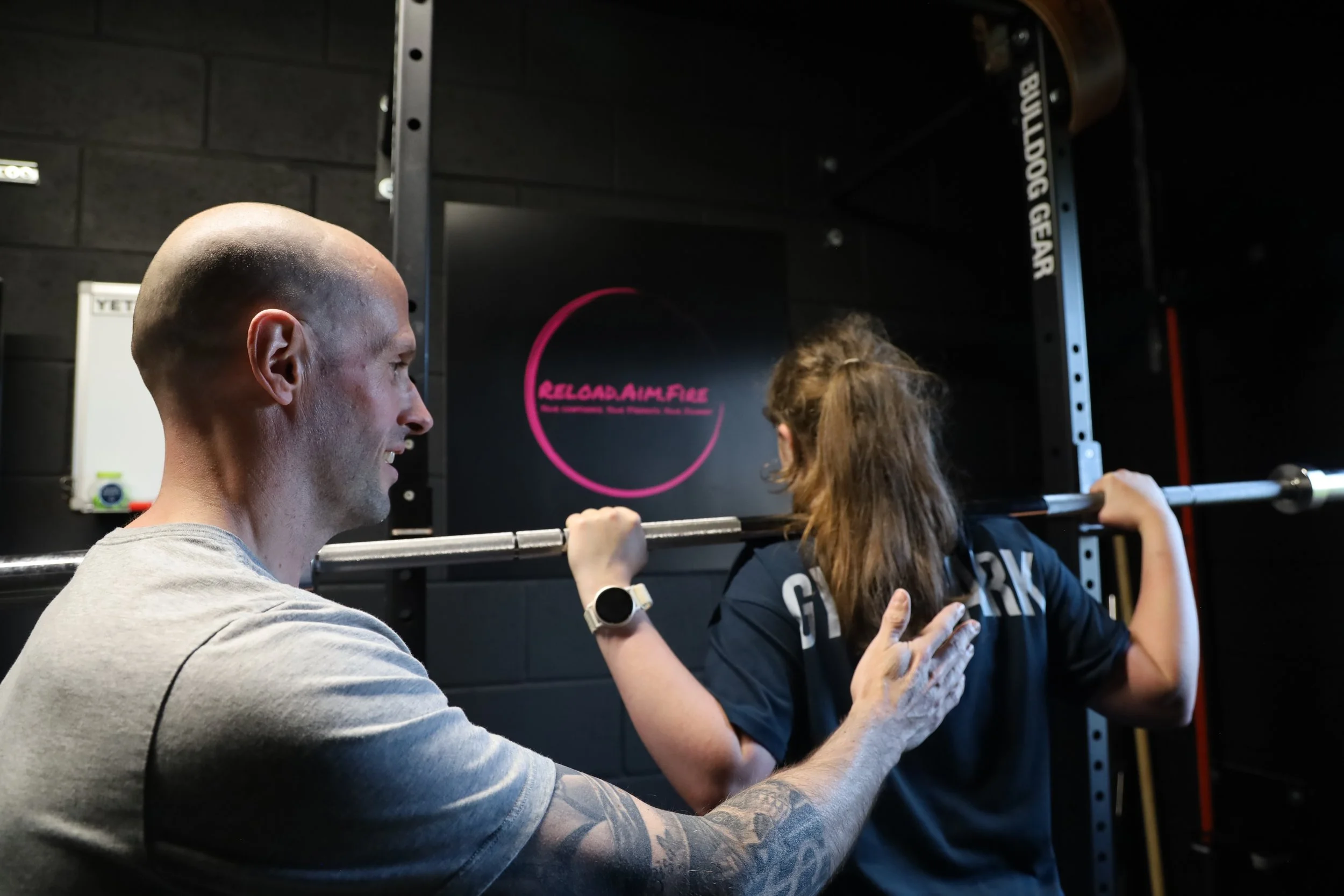
That's exactly what I do. I coach beginners — especially people in their 30s, 40s, 50s and beyond — through their first steps with weights, with a specialism in helping GLP-1 users protect their muscle while the medication does its job. I've been where you're starting from: I lost 30kg and kept my muscle, and I've built my whole coaching approach around making this simple for people who've never set foot in a weights room.
If you want a hand getting started, take a look at my Beginner Course — a proper, structured introduction with a money-back guarantee. No intimidation, no jargon, no judgement.
Reload.Aim.Fire.
Beginner-friendly fitness instructor in Cleator Moor, West Cumbria